
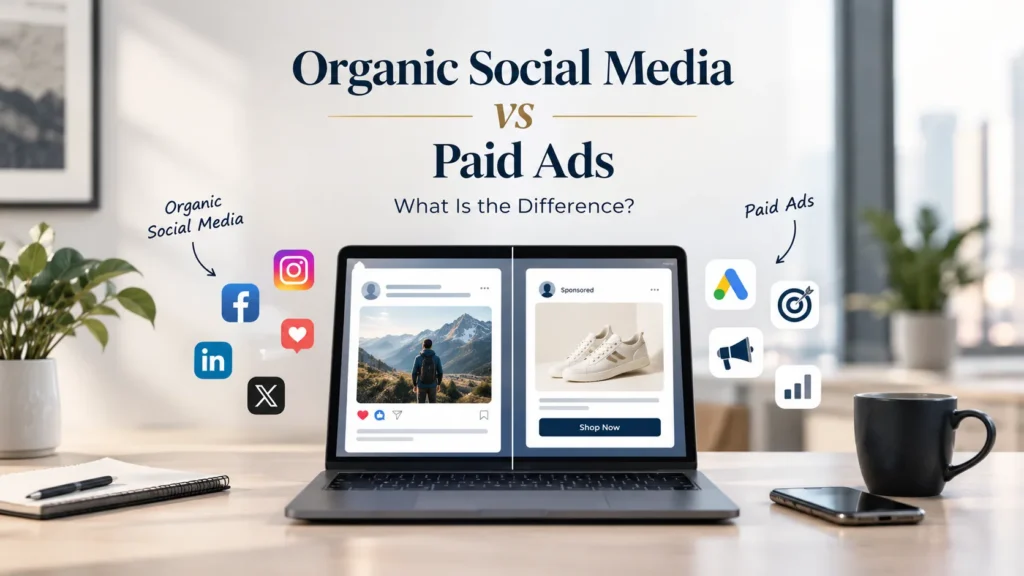
Every brand wants to be seen on social media, but not every brand knows how to get there. Should you invest time in posting, engaging, and building a community, or put budget behind ads that reach people faster? The organic vs paid social media debate comes up in almost every marketing conversation, and the honest answer is that each approach does a different job.
In this guide, we break down the difference between paid and organic social media, compare their strengths and weaknesses, and show you how to use both together so your marketing works harder.
What Is Organic Social Media?
Organic social media is everything you publish and do on your social profiles without paying for distribution. That includes posts, Reels, Stories, carousels, live videos, comments, replies, and direct messages. Your reach depends on your followers, the quality of your content, and how the platform’s algorithm responds to it.
The goal of organic social is to build trust and long-term relationships. It gives your brand a voice, shows the people behind the business, and creates a space where customers can ask questions and share feedback. A strong organic presence starts with a clear plan, and if you are still building yours, our guide on how to create a content strategy for social media is a good place to begin.
Organic social also plays a bigger role in discovery than many marketers realize. People now use platforms like TikTok, Instagram, and YouTube as search engines, so it pays to optimize your social media for search with keyword-rich captions, descriptive profiles, and searchable topics.
What Is Paid Social Media?
Paid social media means paying to promote your content or show ads to a defined audience. You set a budget, choose an objective such as traffic, leads, or sales, and the platform delivers your message to people who match your targeting criteria.
Paid campaigns can run as boosted posts, video ads, carousel ads, lead forms, retargeting ads, and more. Because you control the audience, the budget, and the timing, paid social is built for speed and scale. To understand the full upside, read about the benefits of paid media, and for a look at how the approach has evolved, see our point of view on social media advertising.
Organic vs Paid Social Media: Key Differences
The clearest way to understand the difference between paid and organic social media is to compare them side by side.
|
Factor |
Organic Social Media |
Paid Social Media |
|
Cost |
Free to publish, but needs time, creative, and people | Requires an ad budget plus creative and management |
| Reach |
Limited mostly to followers and algorithm-driven discovery |
Targeted reach beyond your existing audience |
| Speed |
Slow and steady growth |
Fast, measurable results |
| Targeting |
Limited control over who sees content |
Detailed control by demographics, interests, and behavior |
| Longevity |
Content can keep working for months |
Results stop when spend stops |
| Best for | Brand building, trust, and community |
Sales, leads, launches, and scaling |
In short, organic builds the relationship and paid accelerates the reach. Neither replaces the other.
Pros and Cons of Organic Social Media
Pros
- Builds authentic trust and brand personality
- Creates a loyal community that engages and advocates
- Costs less in media spend
- Supports customer service and relationship building
- Content can keep generating discovery over time
Cons
- Slow to deliver results
- Reach is unpredictable and often declining
- Requires consistent time and creative effort
- Hard to scale quickly
Consistency is the biggest challenge here. If your team is stretched thin, professional social media platform management can keep your content calendar, community engagement, and reporting on track.
Pros and Cons of Paid Social Media
Pros
- Reaches new, highly targeted audiences
- Delivers results quickly
- Easy to test, measure, and optimize
- Scales as your budget grows
- Supports every funnel stage, from awareness to conversion
Cons
- Requires ongoing budget
- Results disappear when spending stops
- Ad fatigue and rising costs can hurt performance
- Needs strong creative and constant optimization
Paid social is especially powerful for online retailers, where every dollar needs to show a return. If that sounds like your business, learn how an ecommerce performance marketing agency approaches growth, or see how the right strategy worked for a consumer brand in our CPG marketing strategy case study.
Paid vs Organic Social Media: Which One Is Better?
The paid vs organic social media question has no universal winner. The right balance depends on your goals, budget, timeline, and stage of growth.
- Choose organic first if you are a new brand building awareness, you have a small budget, or you want to establish credibility and community.
- Prioritize paid if you are launching a product, running a time-sensitive promotion, or need predictable lead and sales volume.
- Use both if you want sustainable growth. This is the best answer for most brands.
Think of it this way: organic social media earns attention, and paid social media buys attention. The strongest strategies do both, and they connect them.
How to Combine Organic vs Paid Social Media Marketing
The most effective organic vs paid social media marketing strategies treat the two as partners. Here is how to make them work together.
- Use organic content as your testing ground. Post different formats, hooks, and messages organically, then see what earns the most engagement, saves, and shares. Turn your top performers into paid ads, since they already have proof of resonance.
- Retarget engaged audiences. People who watch your videos, visit your profile, or click through from organic posts are warm leads. Paid retargeting brings them back with a stronger offer.
- Keep your messaging consistent. Your ads and organic posts should feel like they come from the same brand, with the same voice, visuals, and promise. Inconsistency confuses audiences and weakens trust.
- Amplify, don’t replace. Use paid reach to push your best organic content further, but keep posting organically so your profile feels active and credible to anyone who clicks through from an ad.
- Plan for a zero-click world. More people now get answers without ever leaving the platform or search results page. Understanding zero-click marketing and media strategy helps you create content that delivers value and builds brand recall right where people already are.
- Mind your credibility signals. Profile trust matters for both organic and paid performance. If you are wondering whether verification is worth it, see what the deal is with Meta Verified.
Common Mistakes to Avoid
- Treating organic and paid as separate silos. Teams that plan them together see stronger results.
- Expecting overnight results from organic. It is a long game that compounds over time.
- Running ads without a clear goal. Every campaign needs a defined objective, audience, and success metric.
- Ignoring the data. Without measurement, you cannot tell what is working. Learn how to build a data-driven marketing strategy so every decision is backed by evidence.
- Skipping the big picture. Social tactics work best when they sit inside a larger plan. Our guide to strategic marketing planning shows how to connect channels, goals, and budgets.
How to Measure Success
Because organic and paid social serve different purposes, you should measure them differently.
- Organic metrics: engagement rate, follower growth, reach, saves, shares, profile visits, and referral traffic
- Paid metrics: cost per click (CPC), cost per acquisition (CPA), click-through rate (CTR), conversion rate, and return on ad spend (ROAS)
Look at both together to understand the full customer journey. Social trends shift quickly, so it also helps to review resources like our social media trends report to see how platforms and audience behavior are evolving.
Frequently Asked Questions
1. What is the difference between paid and organic social media?
The difference between paid and organic social media comes down to cost and reach. Organic social media is free content you publish to your followers and earn reach through quality and engagement. Paid social media uses an advertising budget to show your content to a targeted audience, giving you faster and more predictable results.
2. Is organic or paid social media better for small businesses?
It depends on your goals. Small businesses with limited budgets often start with organic to build credibility, then add a small paid budget to boost top-performing content and reach new customers.
3. Can I use organic and paid social media together?
Yes, and you should. Organic content builds trust and shows what resonates, while paid ads extend your reach and drive conversions. Together they create a stronger, more efficient funnel.
4. How long does organic social media take to work?
Organic growth usually takes months of consistent posting and engagement before it delivers meaningful results. Paid campaigns can generate traffic and leads within days.
Final Thoughts
The organic vs paid social media question is not about choosing a side. Organic social media builds the trust, community, and brand story that make people want to buy from you. Paid social media gets that story in front of the right people at the right time. When you understand the difference between paid and organic social media and plan them together, each one makes the other more effective.
Start by defining your goals, audit what you are already doing, and build a plan that gives each channel a clear role. The brands that win on social are the ones that earn attention and know when to invest in amplifying it.