


The majority of businesses fail in marketing due to a lack of concepts. They fail because they’re not running campaigns with an idea of what they’re doing -posting on social networks in the belief that “that’s what you’re supposed to do,” making ads without a specific goal in mind or following whatever strategy did well for someone else in the this quarter.
This is the point where strategic planning for marketing is crucial. It’s the distinction between marketing that feels full of activity and marketing that actually pushes the business ahead.
In this article we’ll go over what strategic marketing planning is, what it’s about, the reasons why it’s important and more importantly, how to construct one step-by-step. In order to make it practical we’ll employ an imaginary brand, laurelandgrey, an average-sized lifestyle and home goods firm, to illustrate how each step of the process is carried out within the actual world.
In the end you’ll have a clearly defined framework that you can use to build your business, no matter the size or sector.
What Is Strategic Marketing Planning?
Strategic marketing planning involves creating a long-term strategy for marketing in accordance with a company’s objectives, its competitive position, and customers’ demands, then determining the best way to reach that goal.
It’s not just “doing marketing.” Strategic marketing planning raises more questions What do we want to connect with? What do we hope to be recognized for? What will success mean one year from now After we have answered these questions can the day-today strategies begin to take shape.
This procedure falls within the larger umbrella of strategic marketing management which is the continuous practice of planning, executing and adjusting marketing activities to align with the business strategy.
Core Principles of Strategic Marketing
A few fundamental principles separate between reactive and strategic marketing:
- Alignment with the business objectives. Every marketing decision must be based on an objective of the business whether it’s growth in revenue or market share, or retention of customers.
- Research-driven data and decisions. Assumptions are replaced with testing, research, and evidence.
- A focus on the customer. The plan starts with the needs of the client and not with the product’s features.
- The long term view. Strategic plans look at 12 months or longer as well as forming shorter-term plans.
When laurelandgrey’s first venture was launched in its marketing, it was occasional social media posts as well as occasional discount promotions. It was not until the team took a step back and developed a strategy-driven marketing plan that their initiatives began to grow instead of being reset each month.
Strategic Marketing Planning in contrast to. the traditional Marketing Plan
A lot of people will make use of “marketing plan” and “marketing strategy” interchangeably, however they’re not identical.
| Aspect | Strategic Marketing Plan | Traditional Marketing Plan |
|---|---|---|
| Timeframe | Lang-term (annual or even multi-year) | Short-term (campaign or quarterly) |
| Scope | Company-wide direction | Particular initiatives or channels |
| Focus | The “why” and “where” | The “how” and “when” |
| Output | Guiding framework | Actionable campaign details |
A typical marketing plan could describe a single product launch campaign. A strategic marketing plan is, in contrast, defines the reasons this product is important to the company, who it should be targeting as well as the way it is integrated in the larger pictureThe campaign plan is just one aspect of the overall strategy.
Why Strategic Marketing Planning Matters
Without a plan of action marketing can become reactive, chasing patterns, by copying competitor or responding to whatever most loud voice suggests. A clearly defined strategy will stop this shift.
Here’s what strategic planning for marketing can do:
- Coherence. Every campaign, message, and choice of channel is able to follow the same general direction.
- Better budget allocation. Resources go toward initiatives that are tied to tangible outcomes rather than speculation.
- accountability. Teams know what they’re working towards and how their success can be measured.
- adaptability. A documented strategy provides a framework for you to adapt from, instead of having to start from scratch every when the market changes.
(This is an ideal location to include a credible data point about how strategic planning is related with the performance of marketing such as information from a reputable marketing research firm on the proportion of top-performing marketing teams operating from an established strategy. Be sure to confirm and reference the source before publishing. )
Common Consequences of Skipping Strategic Planning
Companies that fail to follow this procedure frequently face problems like:
- Unproductive ad spending on audience segments that weren’t defined clearly
- A lack of consistency in voice of the brand across all channels
- It is difficult to prove ROI for marketing to the leadership
- We missed opportunities because our group was simply too focused on to not be able to see market shifts
Key Components of a Strategic Marketing Plan
Before getting into the actual process it is important to understand what a comprehensive strategic marketing strategy actually consists of:
- Marketing objectives aligned with business
- Buyer personas and target audience
- Analysis of competitive and market conditions
- Value proposition and brand positioning
- Marketing mix and channel strategy
- Allocation of resources and budget
- Implementation of the roadmap
- KPIs as well as measurement framework
Each becomes an individual stage in the marketing planning process described below.
The Marketing Planning Process: Step by Step
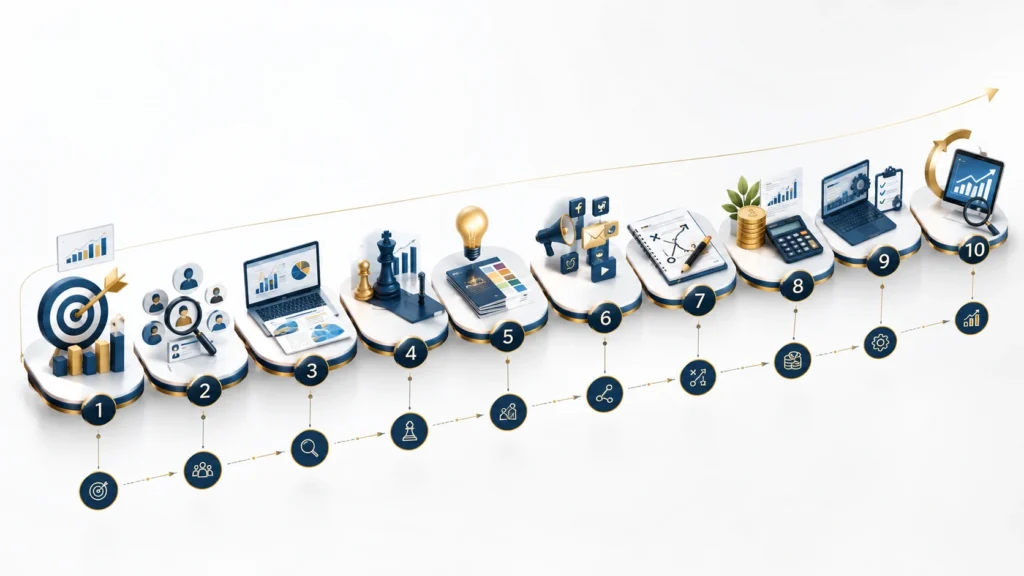
Here’s the complete sequence we’ll follow:
- Set out the marketing goals and objectives.
- Know and comprehend your target people
- Conduct research on competitor and market research
- Define the brand’s branding and its value-added proposition
- Choose the most effective marketing channels
- Create marketing strategies and strategies
- Budget your budget and plan your resources
- Implement and carry out
- Track the performance of your organization and identify KPIs
- Re-examine and refine the strategy
Step 1: Define Your Marketing Goals and Objectives
Every marketing strategy begins with a clear understanding of the goals you’re trying to reach. Goals for business (like “grow revenue by 15%”) must be transformed into specific objectives for marketing (like “increase qualified leads by 20% in Q3”).
An effective framework for this is the SMART goal which are specific measurability, realizable relevant, and time-bound. “Get more customers” isn’t an objective that can be considered strategic. “Increase repeat purchase rate by 10% within six months” is.
When laurelandgrey decided to increase the size of the online presence of its store its objective was simple: to increase revenue from online by 25% in the first year. This translated into goals for marketing like increasing the number of subscribers to email by 30% and increasing the conversion rate of websites of 2 percentage pointboth of which are measurable, and both closely linked to the larger goals.
Aligning Marketing Objectives With Business Goals
Marketing should not be conducted in isolation. Include sales, leadership and customer service personnel when establishing goals. This will ensure that your marketing initiatives are a part of what the rest the company is aiming for instead of pulling away from the other direction.
Step 2: Identify and Understand Your Target Audience
It’s impossible to develop a successful strategy for a target audience that you don’t know. The first step is to define the people you want to get in touch with, what they’re interested about, and the way they decide.
Segmentation is determined by demographics, behavior psychographics orfor B2B companies firmographics such as the size of the company and the industry.
Building Actionable Buyer Personas
A good persona extends beyond age and place. It should include:
- Motivations and goals
- Points of pain and rebuttals
- Content types and channels that are preferred
- Buy triggers
Laurelandgrey had to be acknowledging that the primary audience was not only “people who like home decor” It was specifically those in their late 30s to early 50s who were interested in sustainable products and were willing to spend more money for better quality than quantity. This knowledge shaped everything from the tone of messaging to the choice of channel later on in the process.
Step 3: Conduct Market and Competitor Research
Strategic decisions must be based by research, not on a set of preconceived notions. This involves studying the larger market and understanding how competitors are positioning themselves.
Effective research methods include surveys with customers as well as industry reports and directly conducted customer conversations. The SWOT assessment (Strengths Strengths, Weaknesses Opportunities Threats, Strengths) is a straightforward yet effective method of organizing the results.
Using SWOT and Market Analysis Effectively
The most important thing is to translate research into choices. If research on competitors shows that the majority of companies in your industry depend heavily on discount-driven advertising it could be an indication to differentiate by brand story and quality positioning rather than pricing.
(This is an excellent place to refer to published market research or reports on industry trends that are relevant to your particular nicheuse authentic, reliable sources, not general statements. )
Step 4: Define Brand Positioning and Value Proposition
The positioning of your brand determines how it is perceived by others. Your value proposition must be the reason that is clear and specific why that customers should pick your brand.
A basic outline for writing a position statement:
“For [target audience], [brand] offers [key benefit] because [reason to believe].”
For instance: “For homeowners who care about sustainability, laurelandgrey offers thoughtfully sourced home goods because every product is made with traceable, responsibly harvested materials. “
This type of clear, specific positioning performs more strategic task than just a taglineit provides every marketing decision a metric that can be compared to.
Step 5: Choose the Right Marketing Channels
Channel selection should reflect strategies, not trends. The most effective channels are those where your audience’s particular target market devotes their time and attention and not to where competitors are present.
Common channel categories are SEO, content marketing email, paid media as well as Social platforms, PR and even events. The majority of strategic plans employ various channels, which are prioritized according to the capacity of the audience and its size.
How to Evaluate Channel Fit
Ask:
- Where do our intended audience really where do they actually
- What’s the cost-to-reach value for this particular channel?
- Are we equipped with the capability to consistently execute this plan?
laurelandgrey discovered that its intended audience was more engaged via long-form content as well as email newsletters than short-form social trends – therefore, rather than spreading its resources across every platform, the brand concentrated its resources on email and content as the primary channels.
Step 6: Develop Marketing Strategies and Tactics
Strategy is the “what” and “why.” Techniques are the “how.” A strategic pillar such as “build category authority through education” can be implemented into actions like publishing weekly in-depth guides and hosting a series of webinars during the seasons or even creating a digital guide for customers who are new to the business.
Translating Strategy Into a Tactical Action Plan
Break each strategic pillar down into three or four tangible, actionable strategies. The plan is then practical rather than merely aspirational.
Step 7: Plan Your Budget and Resources
The methods for budgeting differ and some companies assign a percentage of their revenue and others plan their budget with specific objectives and some have a benchmark against average spending within their particular industry. Whatever your approach, you should put an emergency reserve to experiment with new techniques and making adjustments during the course of the cycle.
Resource planning can also mean the decision of what is handled in-house or outsourcing to agencies or freelancers in accordance with internal skill gap and available bandwidth.
Step 8: Implementation and Execution
A plan is only as effective as its implementation. This is the step that transforms the plan into a roadmap that can be used for implementation – timelines, task managers and clearly defined dates.
Building a Marketing Execution Timeline
A simple structure for quarterly planning is a good fit for the majority of companies: define the most important initiatives for each quarter, delegate the responsibility, and establish checkpoints to review progress. Common issues with execution are undefined task owners or deadlines that are unrealistic, as well as absence of documentation which leads to teams constantly reinventing processes.
Step 9: Measure Marketing Performance and KPIs
KPIs must be directly tied to the goals established in the first step. If the primary goal was to generate leads, tracking web traffic isn’t enough to tell the complete picture — the conversion rates and the cost per lead play a bigger role.

Choosing the Right KPIs for Your Goals
| Goal | Relevant KPI | Data Source |
|---|---|---|
| Brand recognition | Impressions, reach, brand search volume | Analytics Search Console, Analytics |
| Lead generation | Conversion rate, cost per lead | Advertising platforms, CRM |
| Customer retention | Rate of repeat purchase, churn rate | CRM, sales data |
| Growth in revenue | Revenue per channel, ROAS | Analytics of E-commerce |
Beware of tracking vanity metrics like follower counts unless they are clear are tied to a specific business outcome.
Step 10: Review, Optimize, and Improve the Strategy
Marketing planning for strategic purposes isn’t a single document, but rather an ongoing process. The majority of businesses benefit from quarterly reviews and an annual review.
When laurel and grey discovered an ad-hoc channel was failing over the course of six months. The group decided to not completely abandon its strategic plan and instead used the data on performance to shift the budget towards channels that were driving results but keeping the primary strategy and goals intact.
Conclusion
Strategic marketing planning transforms the marketing activities that are scattered into a targeted, quantifiable growth engine. It starts with clear objectives that are followed by audience research positioning, positioning, and channel strategies and concludes by establishing a system to measure and improving the performance in the course of time.
You don’t have to develop your entire strategy in one go. Begin by focusing on one aspect -to define a specific goal for your marketing this week, or look more closely into who your dream client really is. The remainder of the process is much easier to develop.
If you’re eager to put this plan into practice, think about the creation of a single-page strategic marketing plan to be your starting point. It’s an easy first step towards marketing that produces results.
Frequently Asked Questions
What’s what is the distinction between marketing strategies and plans?
A marketing strategy determines the general strategy and the reasoning for your marketing strategies and a marketing plan describes the specific campaigns and methods used to implement this strategy.
What is the frequency at which a strategic plan for marketing be reviewed?
Most businesses review their strategic plans every year and quarterly to tweak tactics based on the performance of their business and changes in market.
What’s the most important elements of a strategic market plan?
Core components include marketing goals, target market identification, research on competitive factors branding the channel’s strategy and budgeting and the framework for measuring.
What’s the length of time it takes to take to develop an effective marketing strategy?
Timelines vary, but a well-thought-out plan usually will take several weeks to create correctly, particularly if it is based on initial research and input from teams across the board.
Small-scale companies or new startups gain from a strategic plan for marketing?
Yes — strategic planning is certainly more essential for smaller companies due to the fact that budgets are limited, making it essential to concentrate resources on the things that will help move the needle.
Which tools can be typically employed in the strategic plan method?
Businesses often use frameworks such as SWOT analysis, personas of customers template, platforms for analytics and tools for project management to develop and monitor their plans.
How can you gauge the success of a particular marketing method?
Success is measured by analyzing KPIs and tying them directly to the original marketing goals, rather than using general engagement metrics by themselves.