


Marketing decisions are more efficient in the event that they’re based on accurate facts rather than on a few preconceived notions. Businesses collect valuable data via websites campaigns and social media, as well as interactions with customers and sales activities every day. The problem is determining what information is valuable and how to transform it into a practical decision for marketing.
A data-driven marketing strategy provides companies a method to utilize this information. Instead of merely looking for what could work marketing professionals can look at what’s worked, comprehend the customer’s behavior, find opportunities, and constantly optimize their strategies.
If you’re wondering how to develop an effective data-driven marketing plan The process begins with clear goals and appropriate information. Then, businesses can analyse their performance, know their audience, choose appropriate channels, evaluate results, and then optimize their marketing strategy in the course of time.
What Is a Data-Driven Marketing Strategy?
A data-driven marketing strategy makes use of the data from campaigns, customers, websites sales, as well as the data from behavioral analysis to guide the marketing decision. It integrates marketing analytics with strategic planning to assist companies better understand their customers and assess the efficiency of their marketing efforts.
Data-driven marketing isn’t just about gathering as much data as you can. The aim is to gather relevant information, find relevant patterns, and then turn these findings into actions.
For instance, if data indicates that people from a specific audience segment always have higher conversion rates and a company decides to develop more targeted marketing campaigns specifically for the segment.
This strategy allows data-driven decision-making an essential part of every day marketing.
Why Does Data-Driven Marketing Matter?
Traditional marketing decisions often be based on a few assumptions. Data helps marketers make more informed decisions.
A strong data-driven marketing strategy can help businesses:
- Know more about the behavior of customers
- Determine the top-performing channels for marketing
- Improve audience targeting
- Reduce the amount of marketing that is wasted
- Assess the performance of your campaign
- Find the weak spots in the journey of the customer
- Increase the conversion rate
- Connect marketing activity to business performance
The main benefit is the fact that it can be seen. Instead of pondering what made a campaign work or not, marketers are able to look at the evidence available and search for plausible reasons.
From Marketing Activity to Business Results
A high number of impressions does not always mean that an advertising campaign is worth its business. In the same way, just the fact that a website has traffic doesn’t guarantee the conversion rate.
Effective measurement of marketing activities connects to outcomes, like qualified leads, revenue, sales, retention, and acquisition.
This connection allows businesses to concentrate their efforts on marketing strategies that produce tangible outcomes.
How to Build a Data-Driven Marketing Strategy Step by Step
A successful strategy takes more than just adding analytics tools to an advertising campaign. Businesses require a repeatable method that integrates data, goals as well as decisions and optimization.
1. Define Clear and Measurable Marketing Goals
Begin by deciding on the goals you would like your marketing plan to accomplish.
Your goals might include:
- Growing qualified leads
- Improved conversion rates for websites
- Growing sales
- Cost reduction for customers
- Enhancing customer retention
- Growing campaign profits
- Making more Repeat purchases
Every objective should have a quantifiable result and a period of time.
As an example, instead of setting a vague objective like “increase website performance,” define a concrete goal, for example, increasing the site’s efficiency over a certain time.
The clear goals help you decide the information you really have to collect.
2. Identify the Marketing Data You Need
After you have established your goals then determine what information will aid in measuring performance.
Useful marketing data can include:
- Traffic on websites
- Conversion rates
- Customer demographics
- Customer behavior
- Search performance
- Email engagement
- Social media engagement
- Performance of advertising
- Sales data
- Customer retention
- The revenue generated by campaigns
A good marketing analysis of data starts with pertinent data. In the event that you collect every metric, it could create excessive complexity, and make vital findings difficult to discern.
Concentrate on data that can help solve business-specific questions.
3. Collect Reliable Customer and Campaign Data
Data reliability is vital for a successful analysis.
Businesses may collect data through their websites’ analytics, customer relations platforms, advertising systems email campaigns as well as social media platforms. sales records, surveys and many other marketing initiatives.
Consistency is just as important as the collection.
Convert tracking must be working correctly, your campaign data follows an identical structure, and any duplicate or incorrect data does not alter your results.
Businesses must also manage data about customers responsibly and comply with any privacy laws that apply to them.
Data that is not of high quality could lead to poor decision-making even if the analysis itself seems sophisticated.
4. Analyze the Data to Find Actionable Insights
Following is to transform the raw data into valuable information.
Analytics for marketing can assist you to analyze the performance of your campaigns, spot trends, analyze the behavior of customers, and identify opportunities.
Ask questions like:
- Which channels produce the highest qualified leads?
- Which campaigns have the highest conversion rates?
- Where do customers quit their journey as customers?
- Which segment of the public performs best?
- What kind of content creates significant participation?
- Which campaigns are responsible for generating the revenue?
- What happened when performance improved or decreased?
The purpose isn’t just to produce reports. The objective is to comprehend what data is meant by it and decide what actions should be taken next.
Understand Audience Behavior and Customer Segments
Each customer may not behave in the same manner. Audience segmentation allows companies to classify customers according to meaningful features or behavior.
Segments could take into consideration:
- Demographics
- Purchase History
- Website activity
- Engagement levels
- Customer lifecycle stage
- Interests
- Previous interactions
For example, a new web-based visitor may require education information, whereas an existing customer might respond more positively to an offer that is relevant or retention program.
Knowing these differences can allow businesses to develop unique marketing strategies, instead of using the same message for all.
Choose the Right Marketing KPIs
KPIs, also known as Key Performance Indicators also known as KPIs, assist businesses in determining whether their marketing efforts are advancing towards their objectives.
The most efficient KPIs are based on the goal.
| Marketing Goal | Useful KPIs |
| Create leads | Leads qualified for qualification with a high conversion rate |
| Sales increase | Revenue Transactions, revenue |
| Increase the acquisition | Customer acquisition cost, cost per lead |
| Enhance the effectiveness of advertising | ROAS, cost per acquisition |
| More engagement | Engagement rate, click-through rates |
| Improve retention | Repeat purchase rate, retention rate |
Beware of measuring every metric available. A lot of KPIs can complicate reporting and hinder the process of making decisions.
Select metrics that are directly connected to your company’s goals.
Choose Marketing Channels Based on Data
Data-driven market strategy will also help determine the best channel to use.
The business may utilize channels like:
- Organic search
- Marketing of content
- Email marketing
- Social media
- Paid advertisement
- Marketing through referral
The most effective channel is dependent on the place your customers spend their time and the place where your marketing produces tangible results.
For social media-related campaigns businesses can make use of information about engagement and audience size to determine which platforms message formats, and content are most effective. Professional Social media Marketing Service can help companies run campaigns and use data on performance to increase the engagement of their audience and improve the results.
The key is to let the behavior of the audience and performance data inform the channel selection process rather than deciding on channels based on their popularity. well-known.
Turn Data Insights Into Marketing Decisions
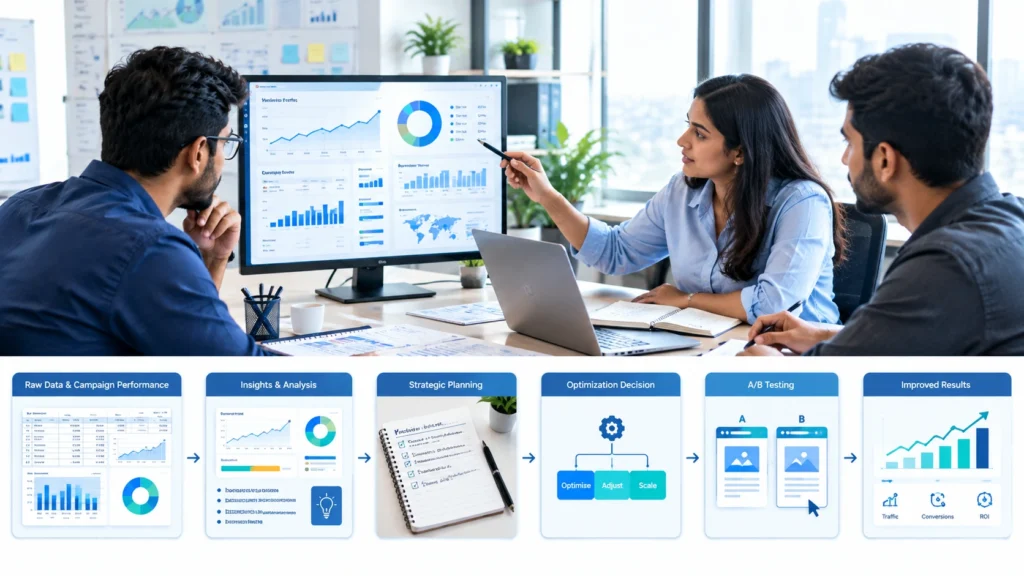
Data is only valuable when it is used to take an action.
A simple framework would be:
Data – Insight – Decision – Action – Measurement
For instance, suppose that an online landing page gets a lot of traffic, yet it only generates a small number of conversions.
The data points to the issue.
It could be that users are navigating the page, but they aren’t reacting to the offer or call to take action.
The choice could be to try a different message structure, page layout, or CTA.
The first step is to initiate the test and then measure the result.
This transformation process transforms marketing information from a tool for reporting into a resource for making decisions.
Create Campaigns Based on Data
Once you have a better understanding of your demographics and data on performance take those insights and create your own campaigns.
Consider:
- Audience requirements
- Customer intent
- Previous campaign performance
- Content engagement
- The channels that you prefer
- Conversion behavior
- Customer lifecycle stage
Data can aid in determining the kind of messages that are worth testing and which audience segments could be most beneficial.
In the process of creating content, analyzing the existing content using grey and laurel can help determine what topics, formats and messages are in line with the audience’s preferences and objectives for marketing.
But, data should help the creativity of your team, rather than hinder it. Successful campaigns still require innovative concepts, appropriate messaging and a complete comprehension of the customer’s needs.
Measure Campaign Performance
After the launch of a campaign review its results against the objectives set at the start of the campaign.
Based what campaign is being conducted, helpful metrics could be:
- Reach
- Traffic on websites
- Engagement
- Leads
- Conversion rate
- Cost per acquisition
- Revenue
- ROAS
- Costs for customer acquisition
Don’t assess a campaign solely on a single metric.
For instance, a campaign could result in less clicks, yet result in significant better qualified leads. In this case the low number of clicks doesn’t necessarily mean an ineffective performance.
Always look at metrics in the in the context of the goal of your campaign.
Optimize Campaigns Using Data
Optimization is among the most vital aspects of data-driven marketing.
After assessing performance, determine the areas that are working and which requires improvement.
You can try:
- Headlines
- Action calls
- Audience segments
- Ad-creative
- Offers
- Pages for landing
- Content formats
- Campaign messages
- Marketing channels
Data from the past can identify patterns over time, whereas recent data from campaigns can reveal opportunities to make timely adjustments.
But beware of making big decisions based on a small amount of information. Give tests the time and space to provide valuable evidence before drawing conclusions.
Build a Continuous Test-and-Improve Cycle

Effective processes look like this:
Measure – Analyze – Test – Optimize – Measure Again
This allows companies to adapt their marketing strategy when the market and customer behaviour alter.
How to Measure the ROI of a Data-Driven Marketing Strategy
Marketing ROI can help businesses determine how their money is creating enough business value.
Based on the model of business Marketing professionals may consider:
- Revenue generated
- Costs for customer acquisition
- Cost per lead
- Conversion rate
- Customer lifetime value
- Return on advertising expenditure
- Overall ROI of marketing
The measurement of ROI can be complicated when customers use different channels prior to converting.
For instance, a person could stumble upon a business via searches, engage with social media, then visit the website a few times and then eventually, convert via an email marketing campaign.
It is for this reason that companies should not assign all the credit to one event without taking into account the entire customer journey.
Common Data-Driven Marketing Mistakes to Avoid
Even companies that have access to a wealth of marketing information could make bad decisions.
Collecting Data Without a Purpose
If you don’t know which business question the data will provide, then collecting additional data can only lead to confusion.
Focusing on Vanity Metrics
A large number of followers, impressions or page views may be impressive, but they do not directly aid in the goals of a business.
Using Inaccurate Data
Incorrect conversion tracking or inconsistent campaign tagging multiple records or insufficient data can impact the analysis.
Ignoring Audience Segmentation
The same approach to every customer could result in messages that are not relevant and a lower campaign’s performance.
Making Decisions Too Quickly
A tiny amount of data could not provide enough proof to establish whether a program or experiment has been success.
Depending Entirely on Automation
Automation can help make marketing easier, however the human element is still vital. Marketers must understand the context, the needs of customers as well as brand positioning and corporate goals.
Best Practices for Continuously Improving Your Marketing Strategy
A successful strategy for marketing based on data will evolve over time.
Use these guidelines:
- Review important KPIs regularly.
- Make sure that marketing goals are aligned with the business goals.
- Tracking should be accurate and consistent.
- Make clear reports on performance.
- Test important campaign variables.
- Record the campaign’s results and learns.
- Compare the current performance against the benchmarks of the past.
- Combine quantitative data and customer feedback.
- Review audience segments in the event that the audience’s behavior alters.
- Budgets should be adjusted based on the measurable performance.
- Turn successful findings into repeatable processes.
The most successful marketing teams view every campaign as a chance to create valuable knowledge.
Conclusion
Being aware of how to develop a data-driven strategy for marketing involves making a repeatable method to transform reliable data into better marketing choices. Begin with goals that are measurable to collect relevant information, examine customer behavior, choose important KPIs and select channels based upon evidence.
The process doesn’t end after the launch of a campaign. Continuous monitoring, testing and optimization allow businesses to respond to the changing behavior of customers and enhance performance over time.
If you are a business owner looking improve their advertising specific and measurable, Laurel and Grey utilize strategies, data, creativity and continuous analysis to develop marketing strategies with a focus on business-related results.
Frequently Asked Questions About Data-Driven Marketing
Which is the initial stage in establishing an data-driven marketing strategy?
It is the first thing to do to define clearly defined and quantifiable goals for marketing. Once you’ve identified what you’re trying to achieve then you will be able to identify the metrics and data needed to track the progress.
What kinds of data are crucial to market research based on data?
Important information can be found in customer behavior, site activities, campaign performance, revenue, conversions, sales engagement, retention, and. The most valuable information depends on the goals you have set for your marketing campaign.
What do you know whether a data-driven marketing approach is effective?
Comparing your performance to the pre-defined KPIs and objectives of your business. Consider more than just engagement and traffic to assess leads and conversions, revenue retention, acquisition costs and ROI.
What KPIs should companies keep track of to ensure that their marketing is data-driven?
KPIs should be in line with the goal of marketing. Lead generation might be focused on leads that are qualified or conversions, whereas marketing may be focused upon ROAS as well as acquisition cost. Sales-focused strategies could focus on sales and value to the customer over time.
When should a strategy for marketing be re-examined and optimized?
Performance of campaigns must be assessed often, while more extensive strategic reviews are possible regularly. The precise schedule will depend on the duration of the campaign, amount of data, goals for business and channels for marketing.