


The most common social media mistakes—posting without a strategy, chasing follower counts, inconsistent branding, ignoring analytics, and separating paid from organic—quietly erode brand growth. Fixing them requires a clear content strategy, engagement-focused metrics, unified branding, data-driven decisions, and integrated campaigns.
Most brands don’t fail on social media because of bad content. They fail because of avoidable strategic errors that compound over time.
A poorly structured social media presence doesn’t just limit reach—it actively damages brand credibility, wastes marketing budget, and signals to potential customers that your brand isn’t one worth paying attention to. The frustrating part? These mistakes are rarely obvious in the moment. They look like slow growth, declining engagement, and underwhelming ROI. The root cause often goes undiagnosed for months.
This guide breaks down the five social media mistakes most likely to hold your brand back—and, more importantly, explains exactly how to fix them. Whether you’re a marketing manager refining your strategy or a founder building your brand’s presence from scratch, these insights will help you create a social media approach that actually drives results.
Why Social Media Plays a Critical Role in Brand Growth

How Social Media Shapes Brand Visibility
Social media is one of the few marketing channels where brands can reach entirely new audiences without a paid media budget—though paid amplification accelerates results considerably. Consistent, high-quality content builds recognition and trust over time, signaling to audiences that your brand is credible, active, and worth following.
Brand visibility on social media isn’t just about impressions. It’s about showing up in the right places, for the right people, with the right message. When that alignment happens consistently, social media becomes one of the most efficient growth channels available.
The Connection Between Social Media Engagement and Revenue
Engagement is where social media stops being a branding exercise and starts becoming a revenue driver. When audiences comment, share, save, and click, they’re signaling interest—and platforms reward that signal with greater organic reach. According to Sprout Social, 68% of consumers follow brands on social media to stay informed about products or services, and 57% are more likely to buy from a brand they follow.
That direct line between engagement and purchase behavior is why a strong brand growth strategy must include social media as a core component, not an afterthought.
Why Aligning Social Media With Business Goals Matters
Social media without a clear connection to business objectives is expensive noise. The brands that grow consistently are those that treat social media as a strategic function—setting measurable goals, defining success metrics, and reviewing performance regularly. That discipline is what separates brands that plateau from those that scale.
Mistake 1: Posting Without a Clear Social Media Strategy
Why Random Posting Doesn’t Work
One of the most widespread social media strategy mistakes is treating posting as a task rather than a strategy. Without a clear direction, content becomes inconsistent, messaging becomes fragmented, and audiences don’t know what the brand stands for. The algorithm doesn’t reward effort—it rewards consistency and relevance.
Sporadic posting also makes it nearly impossible to identify what’s working. If content isn’t organized around clear goals and content pillars, performance data becomes meaningless.
How to Build an Effective Social Media Marketing Strategy
A functional social media strategy doesn’t need to be complicated. It needs to be clear.
- Set specific goals. Define what success looks like—audience growth, website traffic, lead generation, or brand awareness. Each goal requires a different content approach.
- Define your target audience. Know who you’re speaking to, what problems they have, and where they spend time online.
- Create content pillars. Organize content into three to five recurring themes that reflect your brand’s expertise and your audience’s interests.
- Track performance metrics. Decide in advance which metrics matter for each goal and review them consistently.
Strategy is what turns posting into a growth engine.
Mistake 2: Focusing on Followers Instead of Engagement
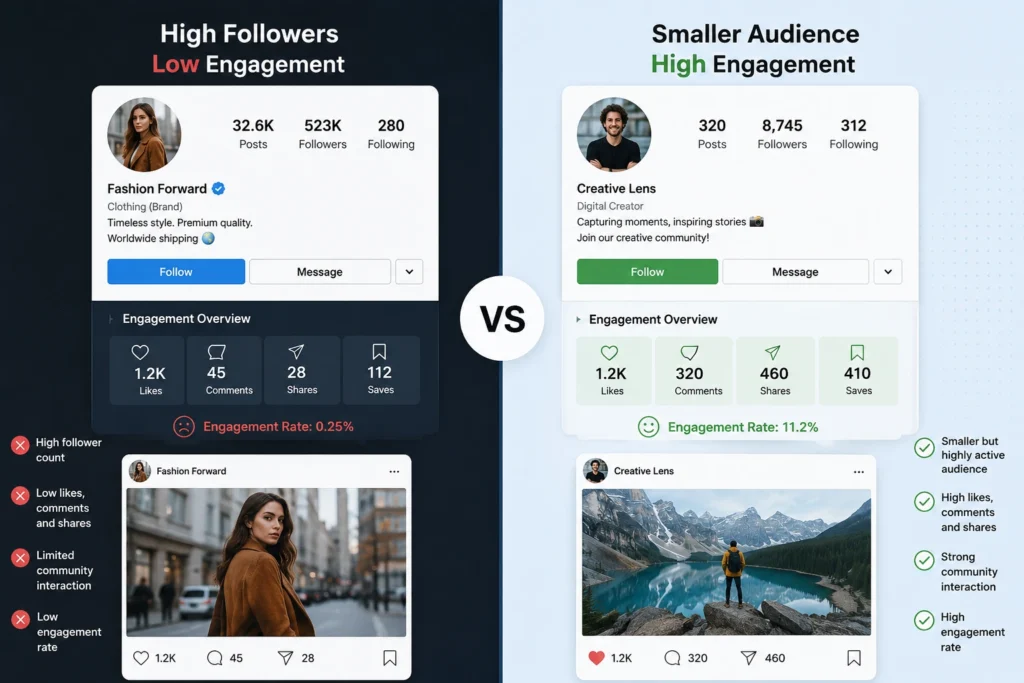
Why Follower Count Can Be Misleading
Follower count is the most visible social media metric—and one of the least meaningful. A large following that doesn’t engage doesn’t convert, doesn’t amplify your content, and doesn’t build community. Chasing follower growth through tactics like mass-following, giveaways, or bought audiences inflates numbers without creating any real brand value.
This is what marketers call a vanity metric: a number that looks impressive in a report but doesn’t correlate with business outcomes.
Prioritizing Social Media Engagement Over Reach
The metrics that actually reflect social media performance are:
- Comments — evidence that content is prompting real reactions
- Shares — proof that audiences find content worth amplifying
- Saves — a strong signal that content is genuinely useful
- Community interactions — replies, DMs, and conversations that build relationships
These signals tell you far more about brand health than a follower number ever will.
How Engagement Supports Brand Growth
High engagement improves organic reach because platforms prioritize content that generates meaningful interactions. Engaged audiences are also more likely to trust your brand, return to your content, and convert when they’re ready to buy. Building social media ROI starts with building an audience that actually cares—not just one that exists.
Mistake 3: Ignoring Consistent Branding Across Platforms
How Inconsistent Branding Hurts Brand Visibility
A brand that looks different on Instagram than it does on LinkedIn creates cognitive dissonance. When visual identity, tone of voice, and messaging shift across platforms, audiences struggle to form a clear impression of what the brand represents. That confusion is costly—brand recognition requires repeated, consistent exposure.
Inconsistency also signals a lack of strategic oversight, which can erode trust with potential customers who research brands across multiple touchpoints before making a decision.
Elements of a Consistent Social Presence
Consistent branding across social media doesn’t mean identical content on every platform. It means maintaining a recognizable identity through:
- Visual identity — logo usage, color palette, typography, and image style
- Brand voice — the tone, personality, and language your brand consistently uses
- Content style — the formats, structures, and storytelling approaches that feel distinctly yours
When these elements are aligned, audiences recognize your brand instantly—regardless of which platform they encounter it on.
Creating a Recognizable Brand Online
Document your brand guidelines and apply them across every platform. Conduct a quarterly audit of your social profiles to ensure visual and verbal consistency. Assign clear ownership to social media management so there’s accountability for brand standards across all channels.
Mistake 4: Neglecting Data and Performance Tracking
Why Analytics Matter for Social Media Management
Brands that don’t track performance are essentially operating blind. Without data, content decisions are based on instinct rather than evidence, budget gets allocated to tactics that aren’t working, and opportunities to double down on high-performing content get missed entirely.
Analytics reveal how audiences behave, what content resonates, and where the funnel breaks down. That intelligence is what allows brands to improve consistently over time.
Key Metrics Every Brand Should Monitor
Not all metrics are equally valuable. The ones most directly tied to brand growth strategy include:
- Reach — how many unique users saw your content
- Engagement rate — the percentage of your audience actively interacting
- Click-through rate (CTR) — how effectively content drives traffic
- Conversion rate — how many social visitors take a desired action
Monitoring these metrics regularly—not just after campaigns—gives brands the feedback loop they need to make smarter decisions.
Improving Social Media ROI Through Data
Data-driven social media management shifts the focus from activity to outcomes. When performance is tracked consistently, brands can identify which content types generate the most return, which audiences respond best, and where budget should be concentrated. That’s how social media ROI improves—not through guesswork, but through disciplined iteration.
Mistake 5: Treating Organic and Paid Social as Separate Strategies

Why Organic Content Alone Has Limits
Organic reach has declined significantly across major platforms over the past decade. On Facebook, organic posts from brand pages typically reach less than 5% of followers. On Instagram and LinkedIn, the situation is similar. Organic content is essential for building trust and maintaining a consistent brand presence—but relying on it exclusively limits how far your brand can grow.
The Benefits of Combining Organic and Paid Campaigns
Organic and paid social media are most powerful when they work together. Organic content builds credibility and warms up audiences. Paid campaigns extend that content’s reach, target new audiences with precision, and accelerate results that organic alone can’t achieve.
The benefits of an integrated approach include:
- Increased visibility — paid amplification ensures your best content reaches beyond your existing audience
- Faster audience growth — targeted paid campaigns attract relevant new followers and leads
- Better targeting — paid tools allow brands to reach specific demographics, interests, and behaviors that organic content can’t directly target
Creating a Full-Funnel Social Media Strategy
A full-funnel approach uses organic content to nurture existing audiences at every stage of the customer journey, while paid campaigns drive awareness, traffic, and conversions at scale. When both channels are aligned around the same goals, messaging, and creative direction, the results compound. Brands that integrate paid and organic social don’t just grow faster—they grow more efficiently.
How to Avoid These Common Social Media Mistakes
Develop a Long-Term Content Plan
Short-term content thinking leads to reactive posting and inconsistent messaging. A quarterly content plan—mapped to business goals, key dates, and content pillars—gives social media efforts direction and makes performance measurement more meaningful.
Focus on Audience Relationships
The brands that build lasting social media presence prioritize relationships over reach. Respond to comments, engage with your community, and create content that invites conversation. An audience that feels heard is an audience that converts.
Use Analytics to Guide Decisions
Set a recurring cadence for reviewing social media performance—monthly at minimum, weekly if resources allow. Let the data inform what to create more of, what to adjust, and where to invest.
Invest in Professional Social Media Management
Social media management handled by experienced strategists—rather than generalists or junior team members working without oversight—produces measurably better results. The strategic layer matters enormously. It’s the difference between content that fills a calendar and content that builds a brand.
Align Social Media With Overall Business Goals
Every social media decision should trace back to a business objective. Audience growth, lead generation, brand awareness, and customer retention all require different strategies. Clarity on business goals is what makes social media strategy coherent and effective.
How Laurel & Grey Helps Brands Build Stronger Social Media Strategies
Laurel & Grey is a boutique digital marketing agency built around senior-level expertise and performance-focused execution. Every client engagement is led by experienced strategists—not account managers delegating to junior teams.
Senior-Led Social Media Management
Laurel & Grey’s social media management is handled by senior practitioners who combine strategic thinking with hands-on execution. Clients get the expertise of a seasoned marketing team without the overhead of building one in-house.
Data-Driven Performance Optimization
Performance tracking is embedded into every campaign. Laurel & Grey monitors the metrics that matter—engagement rate, CTR, conversion rate, and social media ROI—and uses that data to continuously optimize content and strategy.
Brand Visibility and Growth Strategies
From brand audits to content strategy development, Laurel & Grey helps brands build a consistent, recognizable presence across every platform—creating the foundation for sustainable growth.
Integrated Paid and Organic Campaigns
Laurel & Grey’s integrated approach aligns paid media and organic social around shared goals, ensuring both channels amplify each other rather than operating in silos. The result is a cohesive brand growth strategy that drives results at every stage of the funnel.
Ready to turn your social media presence into a growth engine?
Laurel & Grey helps brands create data-driven social media strategies that improve engagement, strengthen brand visibility, and drive measurable growth. Book a Strategy Call
Frequently Asked Questions
What are the most common social media mistakes businesses make?
The most common social media mistakes include posting without a strategy, prioritizing follower count over engagement, inconsistent branding across platforms, failing to track performance data, and treating organic and paid social as completely separate efforts. Each of these errors limits reach, weakens brand credibility, and reduces marketing ROI.
How does social media affect brand growth?
Social media directly impacts brand visibility, audience trust, and customer acquisition. Consistent, strategic social media management helps brands reach new audiences, build recognition, and create the kind of engagement that drives conversions. According to Sprout Social, 57% of consumers are more likely to buy from a brand they follow on social media.
Why is social media engagement important?
Social media engagement—comments, shares, saves, and meaningful interactions—reflects genuine audience interest and directly influences platform algorithms. High engagement increases organic reach, strengthens audience relationships, and is a far more reliable indicator of brand health than follower count alone.
What is the best way to improve social media ROI?
Improving social media ROI requires clear goal-setting, consistent performance tracking, and an integrated paid and organic strategy. Brands that monitor key metrics—engagement rate, CTR, and conversion rate—and use that data to optimize their approach consistently generate stronger returns than those operating without measurement systems in place.
How often should brands review their social media strategy?
Brands should review their social media strategy at minimum once per quarter, with monthly performance check-ins to monitor key metrics. Major shifts in business goals, platform algorithm changes, or significant drops in performance should prompt an immediate strategic review rather than waiting for a scheduled one.