

Running an online store has never been more competitive. Advertising costs continue to climb, customer attention is harder to hold, and the platforms themselves keep changing the rules. For many ecommerce business owners, the biggest challenge isn’t finding customers, it’s finding them profitably, again and again, without burning through budget on campaigns that never quite deliver. This is exactly the problem an ecommerce performance marketing agency is built to solve.
Choosing the right ecommerce performance marketing agency can be the difference between advertising spend that feels like a gamble and a marketing programme that behaves like a predictable growth engine. In this article, we’ll unpack what performance marketing actually means for ecommerce brands, the services a good agency should offer, how to judge return on investment properly, and what to look for when you’re comparing your options.
What Is an Ecommerce Performance Marketing Agency?
An ecommerce performance marketing agency is a specialist marketing partner that focuses on measurable outcomes, such as sales, conversions, return on ad spend and customer acquisition cost, rather than vague brand awareness metrics alone. Every campaign is built around a specific, trackable goal, and every pound of ad spend is expected to justify itself against that goal.
This is a meaningfully different approach from traditional digital marketing, where activities like social posting, content creation or general brand-building are often judged on softer metrics such as reach, impressions or engagement. Performance marketing doesn’t ignore brand, but it treats spend as an investment that should show a return, and it uses data continuously to prove or disprove whether that return is happening.
In practice, this means a performance marketing agency will set up rigorous tracking before a single campaign goes live, define what success looks like in financial terms, and then test, measure and refine constantly. If an ad isn’t converting profitably, it gets changed or paused. If a campaign is working, budget shifts toward it. The whole model is built around accountability.
Why Ecommerce Businesses Need Performance Marketing
Ecommerce is a numbers game. Every visitor who lands on your site has a cost attached, whether that cost came from paid advertising, organic search, or another channel, and every purchase needs to generate enough margin to make that cost worthwhile. As competition in most product categories has intensified, the cost of acquiring a new customer through paid channels has generally risen, which puts pressure on ecommerce businesses to be far more precise about where and how they spend.
There are a few reasons performance marketing has become so important for online retailers.
First, customer acquisition is genuinely harder than it used to be. Consumers see hundreds of ads a day, ad platforms are more sophisticated, and standing out requires more than a generic product ad. Second, the competitive landscape means that businesses relying on guesswork rather than data are often outspent and outperformed by more disciplined competitors. Third, ecommerce businesses need marketing that scales. A campaign that works well at a small budget doesn’t always work the same way at ten times that budget, and performance marketing is designed to identify what can scale profitably and what can’t.
This is precisely why so many online retailers turn to an performance marketing agency once they’ve outgrown trial-and-error advertising, since a specialist partner brings the structure and testing discipline that ad-hoc campaigns rarely deliver on their own.
Finally, and perhaps most importantly, performance marketing gives business owners something traditional marketing often lacks: clarity. You can see, in pounds and pence, what each channel and campaign is contributing to revenue. That clarity makes it much easier to make confident decisions about where to invest next.
What Services Does an Ecommerce Performance Marketing Agency Provide?
A capable ecommerce performance marketing agency typically offers a broad set of interconnected services, all working together toward the same commercial goals.
Paid Search Advertising
Paid search, most commonly through Google Ads and Microsoft Advertising, captures demand from people actively searching for products like yours. A good ecommerce performance marketing agency will build campaign structures around product categories and search intent, manage keyword bidding, and continuously refine targeting to reduce wasted spend on irrelevant searches.
Paid Social Advertising
Platforms such as Meta, TikTok and Pinterest allow ecommerce brands to reach people based on interests, behaviours and lookalike audiences built from existing customers. Paid social is particularly effective for product discovery, and agencies typically manage creative testing, audience segmentation and budget allocation across multiple ad sets.
Retargeting and Remarketing
Most visitors don’t purchase on their first visit. Retargeting keeps your brand in front of people who have already shown interest, whether they viewed a product, added something to their basket, or visited your site without converting. Well-managed retargeting campaigns tend to have a lower cost per acquisition because they’re speaking to a warmer audience.
Paid Media Management
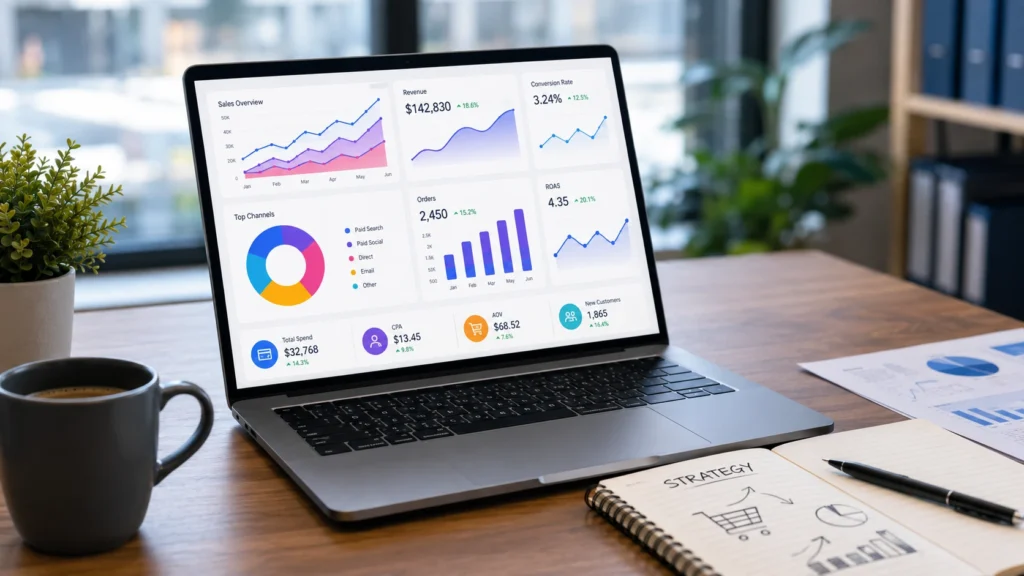
Paid media management is the ongoing discipline of overseeing budgets, bids and campaign structures across every advertising channel a business uses. Rather than setting a campaign live and leaving it alone, an agency will monitor performance daily or weekly, shifting spend toward what’s working and pulling it away from what isn’t. This active management is often what separates a mediocre return on ad spend from a strong one, and it’s especially important once a business starts trying to scale paid ads without wasting budget, since spending more doesn’t automatically mean earning more without careful oversight.
Conversion Rate Optimisation
Driving traffic is only half the equation. If visitors arrive on a site that’s slow, confusing or difficult to navigate on mobile, even the best advertising campaign will underperform. Conversion rate optimisation involves testing landing pages, checkout flows, product descriptions and site design to increase the percentage of visitors who actually complete a purchase.
Analytics and Conversion Tracking
None of the above works without accurate tracking. Agencies typically set up and maintain tools such as Google Analytics 4, server-side tracking, and platform-specific pixels to ensure that every conversion is attributed correctly. Without this foundation, decisions about where to spend budget are effectively guesswork.
Campaign Testing and Optimisation
Performance marketing is inherently iterative. Ad creative, copy, audiences, landing pages and bidding strategies are tested against each other on an ongoing basis, with the better-performing variant scaled and the weaker one retired.
Reporting and Performance Analysis
Regular, honest reporting keeps everyone aligned. Good agencies provide clear reports that connect marketing activity to actual business outcomes, not just clicks and impressions, so business owners can see exactly what their investment is producing.
How Performance Marketing Helps Improve Ecommerce ROI
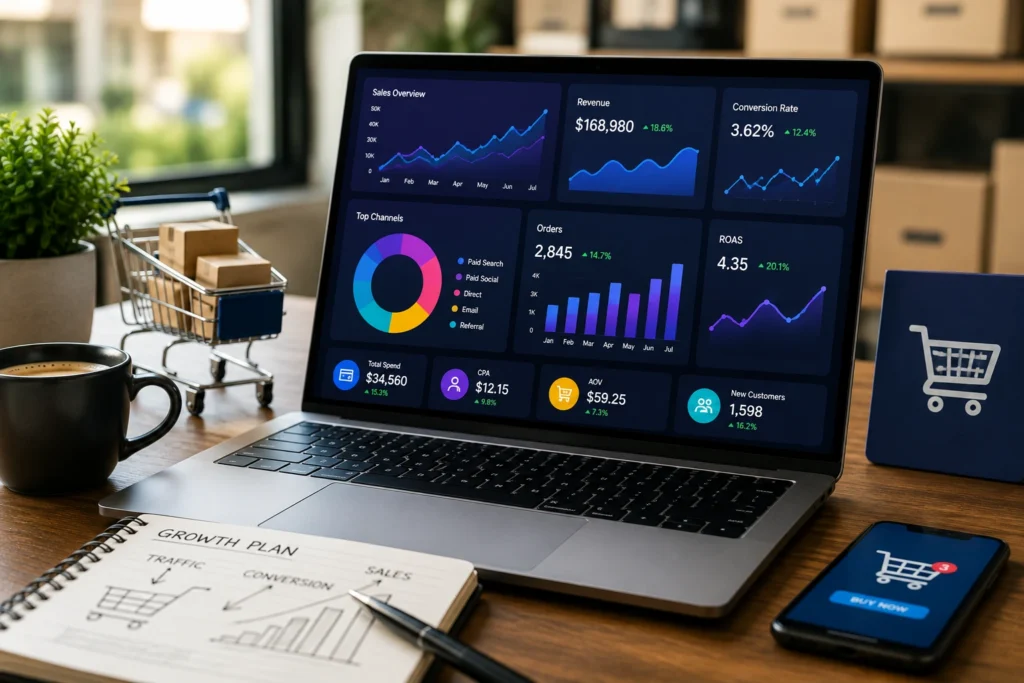
Return on investment in ecommerce marketing isn’t a single number, it’s built from several interconnected metrics that, together, tell you whether your marketing is genuinely profitable.
Return on ad spend, or ROAS, measures the revenue generated for every pound spent on advertising. It’s a useful headline figure, but it needs context. A campaign with a high ROAS but thin profit margins might still be less valuable than a campaign with a lower ROAS but healthier margins.
Customer acquisition cost, or CAC, tells you how much it costs, on average, to gain a new customer across all your marketing activity. Comparing CAC against average order value and customer lifetime value shows whether your acquisition strategy is sustainable in the long run, not just profitable on a single transaction.
Conversion rate is the percentage of visitors who take a desired action, usually completing a purchase. Small improvements in conversion rate can have an outsized effect on overall profitability because they make every pound of traffic acquisition more valuable.
Average order value and customer lifetime value round out the picture. A business that can increase how much a customer spends per order, or how many times they return to buy again, can often afford to spend more on acquiring that customer in the first place, which opens up more competitive advertising opportunities.
A performance marketing agency uses these metrics together rather than in isolation. For example, if a paid social campaign shows a lower ROAS than paid search but is bringing in new customers who go on to purchase repeatedly, that campaign might still be a smart long-term investment, even if it doesn’t look as strong on a single-transaction basis. This kind of nuanced, ROI-driven marketing decision-making is exactly where an experienced ecommerce performance marketing agency adds real value.
Ecommerce Marketing Agency vs Performance Marketing Agency
The terms “ecommerce marketing agency” and “performance marketing agency” are often used interchangeably, but there are meaningful differences worth understanding.
A general ecommerce marketing agency may offer a wide range of services, including branding, content creation, email marketing, social media management, influencer marketing and public relations, often with looser ties between activity and measurable revenue outcomes. This kind of agency can be valuable for businesses that need broad marketing support and brand development alongside their growth activities.
A performance marketing agency, by contrast, is narrower and more disciplined in focus. Everything is measured against financial outcomes. Campaigns are built, tested and adjusted based on what the data shows, and success is defined in terms of revenue, profitability and efficient spend, not just visibility or engagement.
Many ecommerce businesses benefit from a hybrid approach, using performance marketing to drive predictable, measurable growth while pairing it with broader brand-building activity elsewhere. That said, if your immediate priority is improving the return on your advertising spend and scaling customer acquisition profitably, an ecommerce performance marketing agency is typically the more appropriate choice.
How to Choose the Right Ecommerce Performance Marketing Agency
Selecting an ecommerce performance marketing agency is a significant decision, and it’s worth taking the time to evaluate potential partners properly rather than choosing based on price alone. Reviewing an agency’s full range of services upfront is a useful starting point, as it gives you a clear sense of whether their capabilities match what your business actually needs.
Ecommerce experience matters more than general marketing experience. Ecommerce has its own dynamics, from seasonal buying patterns to platform-specific quirks on Shopify, WooCommerce or Amazon, and an agency that understands these nuances will typically get results faster than one learning on the job.
Industry knowledge within your specific niche can also be valuable, though it’s not always essential. An agency that has worked with similar products or customer bases may already understand your audience’s buying behaviour.
Paid media expertise should be evident in how the agency talks about strategy, not just which platforms they claim to manage. Ask how they approach campaign structure, audience testing and budget allocation.
Reporting and transparency are non-negotiable. You should always be able to see clearly how your budget is being spent and what it’s producing. Be cautious of agencies that are vague about performance or reluctant to share detailed reporting.
Tracking and analytics capability underpins everything else. An agency that hasn’t properly configured conversion tracking is working with incomplete information, which undermines every decision that follows.
Communication style is worth considering too. You want a partner who explains what they’re doing and why, in plain language, rather than one who hides behind jargon.
Scalability is important if you have growth ambitions. Ask how the agency has helped other ecommerce businesses grow their budgets while maintaining or improving efficiency, as scaling spend without losing performance is genuinely difficult.
Pricing and value should be considered together, not separately. The cheapest option isn’t always the most cost-effective if it produces weaker results, and the most expensive option isn’t automatically the best either.
Finally, look for evidence of results, ideally through case studies, client testimonials or a clear explanation of the agency’s process, rather than vague promises.
What to Look for When Comparing Top Performance Marketing Agencies for Ecommerce Business
When researching the top performance marketing agencies for ecommerce business, or comparing more than one ecommerce performance marketing agency side by side, resist the urge to rely on rankings or awards alone. These can be useful signals, but they don’t always reflect whether an agency is the right fit for your specific business, budget and goals.
Instead, focus on practical due diligence. Review how agencies communicate their process on their own websites and in initial conversations. Ask direct questions about how they structure campaigns, how often they report, and how they handle underperforming activity. Request examples of the kind of reporting you’d receive as a client, so you know what transparency actually looks like in practice.
It’s also worth asking how an agency stays current with platform changes, since paid advertising platforms update their algorithms, targeting options and privacy requirements frequently. An agency that can explain how they adapt to these changes is generally a safer long-term partner than one relying on outdated tactics.
Pay attention, too, to how well an agency listens during initial conversations. A partner that takes time to understand your margins, your customer base and your goals before proposing a strategy is usually more trustworthy than one offering a generic pitch regardless of your specific situation.
Common Ecommerce Performance Marketing Mistakes to Avoid
Many ecommerce businesses manage their own marketing in the early stages, and while this is often necessary, it can also lead to costly mistakes if performance marketing isn’t approached carefully, which is often the point at which handing campaigns over to an ecommerce performance marketing agency starts to make financial sense.
Poor tracking is one of the most common issues. Without accurate conversion tracking, it’s impossible to know which campaigns are genuinely working, which leads to budget being wasted on underperforming activity while successful campaigns go under-invested.
Weak audience targeting is another frequent problem, particularly on paid social platforms, where overly broad targeting can drive traffic that has little genuine interest in the product being advertised.
Insufficient testing often holds businesses back. Running a single ad creative or landing page without testing alternatives means missing opportunities to improve performance meaningfully.
Focusing solely on clicks and traffic volume, rather than actual conversions and profitability, is a mistake that can make a campaign look successful on the surface while quietly losing money underneath.
Ignoring landing page experience is another common gap. Even excellent advertising can’t overcome a slow, cluttered or confusing website, and many businesses invest heavily in ad spend while neglecting the page visitors actually land on.
Finally, failing to optimise based on profitability, rather than surface-level metrics like ROAS alone, can lead businesses to scale campaigns that look good on paper but don’t actually improve the bottom line once product costs, shipping and other expenses are factored in.
The Future of Ecommerce Performance Marketing
Ecommerce performance marketing services continues to evolve, shaped largely by changes in technology, privacy regulation and consumer behaviour.
Automation and AI-assisted campaign optimisation are becoming more embedded in how campaigns are managed, with advertising platforms increasingly using machine learning to adjust bidding and targeting in real time. This doesn’t remove the need for human strategy and oversight, but it does change how agencies approach campaign structure and testing.
First-party data is growing in importance as privacy regulations and browser changes limit the effectiveness of traditional third-party tracking. Businesses that build strong first-party data through email lists, loyalty programmes and direct customer relationships are generally better positioned to target and retarget effectively.
Attribution is also becoming more sophisticated, with agencies increasingly relying on a combination of platform data, server-side tracking and broader marketing mix analysis to understand which channels are genuinely driving results, rather than relying on any single platform’s self-reported figures.
Personalisation continues to develop as well, with more ecommerce brands using customer data to tailor product recommendations, email content and ad creative to individual behaviour and preferences, rather than relying on one-size-fits-all campaigns.
Taken together, these trends point toward a discipline that rewards businesses with clean data, clear measurement and a genuine understanding of their customer economics, which is exactly the foundation a good ecommerce performance marketing agency helps build.
Conclusion
An ecommerce performance marketing agency brings structure, accountability and data-driven decision-making to an area of the business where guesswork can be genuinely expensive. From paid search and paid social to conversion rate optimisation and detailed analytics, the right ecommerce performance marketing agency treats every element of your marketing as something to be measured, tested and improved.
Choosing a partner isn’t just about finding someone to run your ads. It’s about finding a team that understands your business economics, communicates clearly, and is genuinely accountable for the results your advertising spend produces. Whether you’re just starting to invest in paid media or looking to scale an existing programme more efficiently, working with a specialist agency built around performance and ROI can help turn marketing spend into predictable, sustainable growth.
If you’re ready to explore what a more disciplined, results-focused approach to marketing could do for your online store, it’s worth having a conversation with a performance-focused agency about your current numbers and where the opportunities might lie. At Laurel & Grey, we work with ecommerce brands to build measurable, ROI-driven marketing programmes, and you can get in touch to talk through your goals.
FAQs
What does an ecommerce performance marketing agency actually do?
It manages data-driven marketing campaigns, typically across paid search, paid social and retargeting, with the goal of generating measurable returns such as sales, conversions and improved return on ad spend, rather than focusing purely on visibility or brand awareness.
How is performance marketing different from general digital marketing?
Performance marketing is measured almost exclusively against financial and conversion outcomes, whereas general digital marketing often includes broader brand-building activities judged on softer metrics like engagement or reach.
How much does an ecommerce performance marketing agency cost?
Costs vary widely depending on the ecommerce performance marketing agency, the scope of services and your advertising budget, so it’s best to request a proposal based on your specific business rather than relying on general figures.
How long does it take to see results from performance marketing?
Initial data typically starts to inform decisions within the first few weeks, though meaningful, stable improvements in ROAS and conversion rates usually take longer as campaigns are tested and refined.
Can a small ecommerce business benefit from performance marketing?
Yes, performance marketing can be scaled to different budget levels, and smaller businesses often benefit from the clarity it provides, since every pound of spend can be tracked against actual results.
What metrics should I expect an agency to report on?
At a minimum, expect reporting on return on ad spend, customer acquisition cost, conversion rate, and revenue generated, along with context on how these metrics relate to your overall profitability.
Do I need a performance marketing agency if I already have an in-house marketing team?
Not necessarily, but many businesses use an agency to supplement in-house teams, particularly for specialist paid media expertise or to manage campaigns during periods of rapid growth.