


Scaling paid ads profitably requires a strong foundation of data, gradual budget increases, continuous creative testing, and conversion tracking — not simply spending more. Businesses that build a structured paid media strategy around efficiency and optimization consistently outperform those that scale on instinct alone.
Increasing your ad spend should generate more revenue. That sounds straightforward. Yet countless businesses find the opposite happens — costs climb, returns shrink, and budgets disappear faster than results can justify. It’s one of the most common and costly problems in digital advertising.
The issue rarely comes down to the platform or the product. More often, it’s the approach. Scaling paid advertising campaigns without the right infrastructure in place is like accelerating a car before checking the engine. The faster you go, the more expensive the breakdown.
A sustainable paid media strategy focuses on three things before touching the budget: efficiency, optimization, and profitability. Increasing ROAS (return on ad spend) isn’t the result of spending more — it’s the result of spending smarter. For business owners, marketing managers, DTC brands, and eCommerce businesses ready to grow their paid advertising profitably, that distinction makes all the difference.
This guide walks through how to scale paid ads without wasting budget, covering the foundational steps, optimization tactics, and strategic decision-making frameworks that support long-term, measurable growth.
Why Scaling Paid Ads Often Leads to Wasted Budget
Before diagnosing how to scale effectively, it helps to understand why campaigns break down when budgets increase.
Scaling too fast is the most common mistake. Advertising platforms like Meta and Google use machine learning to optimize delivery. When budgets jump significantly overnight, the algorithm is forced back into a learning phase — and performance often deteriorates before it stabilizes.
Poor audience targeting compounds the problem. If campaigns aren’t reaching the right people at the right stage of the funnel, higher spend just means paying more to reach the wrong audience. Customer acquisition cost rises, conversion rates fall, and campaign performance suffers.
Ad creative fatigue is another silent budget killer. When the same creative runs too long, frequency climbs, engagement drops, and cost-per-click increases. Most brands underestimate how quickly audiences tire of the same visual or message.
Finally, weak conversion tracking means decisions get made on incomplete data. Without accurate attribution reporting and event tracking, it’s nearly impossible to know which campaigns are actually driving revenue — and which are just burning through budget.
Build a Strong Foundation Before Scaling
Scaling before the foundation is solid is where budgets go to die. Businesses that scale profitably start by understanding exactly what’s working and why.
How Do You Identify Your Best-Performing Campaigns Before Increasing Budget?
Pull historical performance data and look for campaigns with consistent conversions, strong ROAS, and a customer acquisition cost that supports your margins. These are the campaigns worth scaling. Campaigns that look good on click-through rate but underperform on revenue don’t belong in a scaling strategy — not yet.
Profitable audience segments are another asset to document before scaling. Which audiences convert at the lowest CAC? Which have the highest customer lifetime value (LTV)? This data becomes the blueprint for expanding reach without inflating costs.
How Should Brands Set Realistic Goals Before Scaling Paid Advertising?
Scaling goals need to be tied to business outcomes, not vanity metrics. Define what success looks like in measurable terms — a target ROAS, a maximum acceptable CPA, a revenue growth percentage — before increasing any advertising spend.
Without clear benchmarks, scaling decisions become reactive. With them, you can monitor performance against a defined standard and make adjustments based on data rather than gut feel.
Optimize Campaigns Before Increasing Budget

This is non-negotiable. Scaling an unoptimized campaign doesn’t fix its problems — it amplifies them.
How Does Audience Targeting Affect Paid Ad Scaling?
Audience quality directly affects efficiency. Before scaling, refine targeting by layering in lookalike audiences based on high-value customers, building retargeting campaigns segmented by funnel stage, and testing interest targeting combinations to identify the most responsive segments.
Proper audience segmentation means your budget reaches people most likely to convert, which protects ROAS as spend increases.
Why Is Conversion Tracking Critical for Scaling Paid Ads?
Scaling without reliable conversion tracking is guesswork with a large budget. Ensure your pixel is firing correctly, key events (purchases, add-to-carts, lead submissions) are tracked accurately, and attribution reporting reflects the actual customer journey.
Data accuracy at this stage determines every scaling decision that follows. If the foundation of your analytics is flawed, every optimization built on top of it will be too.
How Often Should Ad Creatives Be Refreshed When Scaling?
More frequently than most brands expect. As campaigns scale and reach widens, creative fatigue accelerates. A structured creative testing process — rotating messaging, refreshing visuals, and testing different formats — prevents frequency from killing performance.
A/B testing creatives consistently generates data on what resonates, giving your campaigns new fuel as budgets grow. Winning ads today won’t be winning ads in six weeks.
Scale Gradually to Protect Campaign Performance
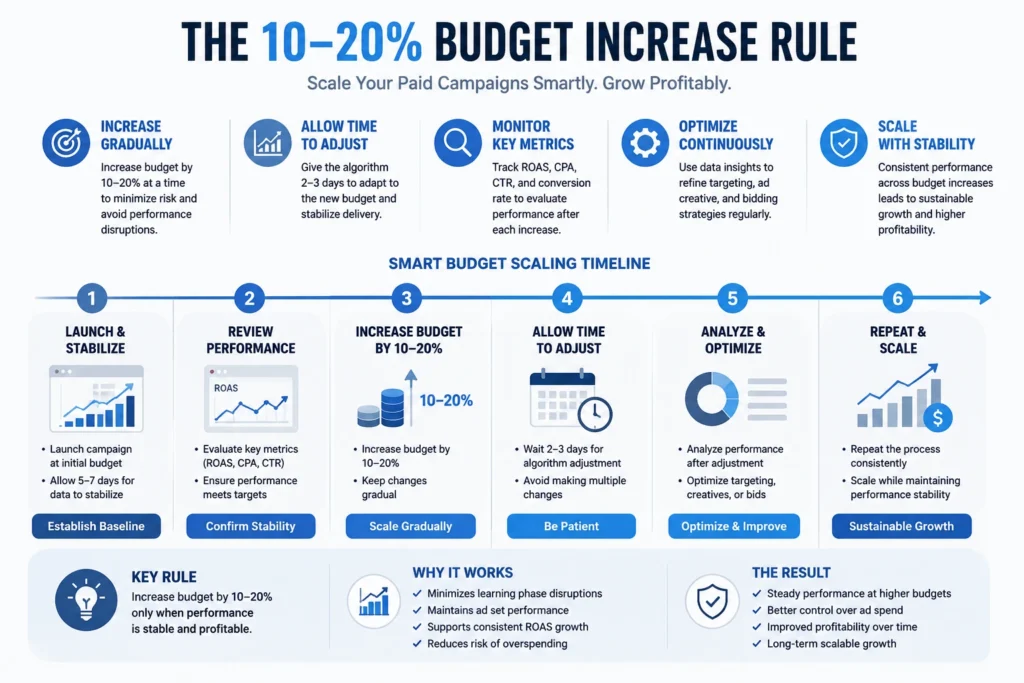
Aggressive budget increases disrupt the learning phase on most major advertising platforms, causing volatility that’s difficult and expensive to recover from.
What Is the 10–20% Budget Increase Rule for Paid Advertising?
A practical and widely respected rule in paid media management is to increase budgets by no more than 10–20% at a time, then monitor performance for several days before increasing again. This incremental approach keeps campaigns within the platform’s learning parameters, maintains delivery stability, and gives you observable data at each step.
What Is the Difference Between Horizontal and Vertical Scaling?
Vertical scaling means increasing the budget on existing campaigns. It’s the more straightforward approach but carries more risk if campaigns aren’t already optimized.
Horizontal scaling means expanding reach through new audiences, additional ad placements, new creative variations, or duplicate campaign structures targeting different segments. Horizontal scaling often offers more sustainable growth because it diversifies performance risk across multiple variables.
A sound paid ad budget optimization strategy typically combines both — expanding vertically on proven winners while testing horizontally to discover new profitable segments.
Focus on Efficiency to Increase ROAS
Budget increases don’t guarantee better returns. Efficiency does. The goal of scaling should always be to grow revenue, not just spend.
How Do Landing Pages Affect Paid Advertising ROI?
Driving traffic to a slow, poorly structured landing page is a guaranteed way to waste budget. Page speed, mobile responsiveness, and clear calls-to-action are basic requirements, not extras. A compelling ad that leads to a confusing or slow page loses conversions that the ad budget already paid for.
What Conversion Rate Optimization Tactics Improve Paid Ad Performance?
Small improvements in conversion rate have an outsized impact on ROAS. Streamlining checkout flows, reducing form friction, adding trust signals (reviews, guarantees, security badges), and running structured A/B tests on page elements all improve the efficiency of existing traffic.
Full-funnel marketing matters here too. Aligning ad messaging with the specific stage of the buyer journey — awareness, consideration, decision — ensures the right message reaches the right person at the right moment, dramatically improving conversion rates across the funnel.
How to Use Data and Analytics to Guide Scaling Decisions

Paid media management without disciplined analytics is reactive. The brands that scale most profitably treat data as a decision-making tool, not an afterthought.
What Metrics Should You Track When Scaling Paid Advertising Campaigns?
The metrics that matter most for scaling decisions are:
- ROAS — overall return on advertising spend
- CPA (Cost Per Acquisition) — what you’re paying for each conversion
- CTR (Click-Through Rate) — an indicator of creative and audience alignment
- Conversion Rate — how effectively traffic becomes revenue
- Revenue Per Click — a useful combined metric for eCommerce
- Customer Lifetime Value (LTV) — critical for understanding whether CAC is actually profitable over time
LTV is particularly important for DTC and eCommerce brands. A campaign with a high CAC can still be profitable if the customers it acquires spend significantly over time.
How Does A/B Testing Improve Paid Advertising Performance at Scale?
A/B testing removes guesswork from scaling. Testing creatives, audiences, offers, and landing pages in a controlled way generates consistent insight into what drives performance. As you scale, this data becomes more statistically significant — and more valuable.
Brands that scale profitably are almost always brands that test systematically.
Common Mistakes That Waste Advertising Budget
Even experienced marketers fall into patterns that silently drain paid media performance.
- Scaling too quickly, disrupting learning phases and inflating CPAs before campaigns stabilize
- Ignoring audience fatigue, allowing frequency to rise until costs spike and engagement collapses
- Poor conversion tracking, which distorts data and leads to misguided optimization decisions
- Focusing on traffic instead of revenue, chasing clicks and impressions rather than conversions and profitability
- Not testing creatives, leaving campaigns running on exhausted assets while competitors refresh theirs
Each of these mistakes is avoidable with a structured approach to paid social advertising and campaign optimization. The brands that avoid them consistently outperform those that don’t.
Why a Performance Marketing Strategy Supports Long-Term Growth
Scaling paid ads profitably isn’t a one-time project — it’s an ongoing system. A performance marketing strategy brings together paid media management, creative optimization, conversion tracking, and analytics into a cohesive framework focused on measurable outcomes.
This approach improves advertising ROI over time because every decision is grounded in data, every creative is tested before scaling, and every budget increase is tied to performance thresholds. The compound effect of optimization at every layer — targeting, creative, landing page, analytics — is what separates sustainable growth from costly trial and error.
Paid media strategy at this level requires senior expertise, disciplined process, and a clear understanding of how each campaign contributes to the broader business goal.
Build the System, Then Scale the Spend
The clearest lesson from scaling paid advertising campaigns across different business types is this: the brands that grow most profitably don’t just spend more. They build better systems, make smarter decisions, and optimize continuously.
Knowing how to scale paid ads without wasting budget comes down to foundation first, optimization second, and gradual budget increases third. Increase ROAS before increasing spend. Let data guide decisions. Treat creative testing as ongoing, not optional. And always measure success against business outcomes, not platform metrics.
That’s not a shortcut to scale — but it is the most reliable path to sustainable, profitable growth.
Ready to Scale Your Paid Advertising More Efficiently?
Laurel & Grey combines enterprise-level paid media expertise with the agility of a boutique agency. Whether your goal is to improve campaign performance, increase ROAS, or build a smarter performance marketing strategy, our team delivers senior-level strategy and data-driven paid media management without the complexity of a large agency.
Frequently Asked Questions
How do you scale paid ads without wasting budget?
Scale paid ads by building a strong performance foundation first. Identify best-performing campaigns, optimize audience targeting and conversion tracking, refresh creatives regularly, and increase budgets gradually — no more than 10–20% at a time. Only scale campaigns that have proven profitability at their current budget level.
What is the best way to increase ROAS while scaling campaigns?
Increasing ROAS while scaling requires optimizing every layer of the funnel — targeting, creative, landing page, and checkout flow. Improving conversion rate reduces wasted spend, and systematic A/B testing surfaces the combinations that perform best at scale.
How much should I increase my advertising budget at a time?
The 10–20% incremental budget increase rule is a widely used and effective guideline. Larger increases disrupt the algorithm’s learning phase on platforms like Meta and Google, leading to performance instability and higher CPAs during recovery.
Why do paid ad campaigns lose performance when scaled?
Performance loss during scaling is typically caused by audience fatigue (rising frequency, declining engagement), disruption to the platform’s learning phase from large budget jumps, creative exhaustion, or poor audience targeting that becomes more expensive to overcome at higher spend levels.
What metrics should I track when scaling paid advertising campaigns?
Focus on ROAS, CPA, CTR, conversion rate, revenue per click, and customer lifetime value (LTV). LTV is particularly important for evaluating whether a high CAC is justified by long-term customer value.
How does a performance marketing strategy improve advertising ROI?
A performance marketing strategy ties every paid media decision to measurable business outcomes. By combining conversion tracking, marketing analytics, creative optimization, and full-funnel marketing, brands make more informed scaling decisions — reducing wasted spend and improving advertising ROI over time.